Wednesday, September 22, 2010

An Exotic day at Great Dixter

It's been a busy weekend. First, I spent Friday in Oxford with my daughter. It was the university's open day, so we were looking at colleges and going to various presentations on a preliminary fact-finding mission - she won't apply until next year.
Saturday, having dropped daughter at home, I went back to Oxfordshire, to Woodstock to have lunch with friends and see their garden. (Gorgeous, but I forgot my camera.)
Sunday, I was at the Woodstock Literary Festival, held at Blenheim Palace, where I was interviewing Helena Attlee about her new book, Italy's Private Gardens. I'd been a bit nervous about it, but in retrospect, that seems silly because it was a dream assignment. The book is absolutely mouth-watering and Helena has an endless supply of stories and anecdotes, all equally fascinating, about her experiences and the people she met along the way. VP was there, and you can read all about it on her blog.
I hadn't intended to have such a busy time, because months ago I had signed up to do a study day at Great Dixter on exotic plants. Monday was the day, and here I was - knackered! I'd driven home down the M40 on Sunday in the usual bumper-to-bumper Sunday night traffic, and then set off for East Sussex (another two-hour drive) first thing Monday morning.
It is a huge tribute to Great Dixter head gardener Fergus Garrett's lecturing skills that I did not fall asleep during the first session.
I arrived at Dixter at about 9.45am. It was a chilly, misty morning so I was delighted to be welcomed with a cup of tea in the Great Hall. Outside, the air smelt of autumn - damp leaves, wet earth and the seductive scent of woodsmoke.
We were ushered into the Benenden Hall, where the source of the woodsmoke turned out to be a truly baronial fire. Packs were provided for each student which included a list of slides and - hurray - a pencil. (Like most journalists, I never seem to have a pen when I need one.)
Fergus ran through the day's events. There would be slides and a lecture all morning, with a break for coffee, then lunch. After lunch, there would be a tour of the garden, including the glasshouses and cellars, followed by a detailed look at the Exotic Garden, and a practical demonstration. This would be followed by tea and a chance to buy plants.
I loved Fergus's lecture. He told us about the beginning of exotic planting at Dixter, and how he and Christopher Lloyd had been inspired by a range of influences, including the work of Dan Benarcik at the Chanticleer gardens near Philadelphia. Another inspiration was Ray Waite, the former superintendent of glasshouses at RHS Wisley, in Surrey.
Christo, said Fergus, wanted to take people "closer to the Equator", while he liked the idea of leading people into a Rousseau painting.
Next came the plants. Slide after slide of alluring specimens appeared, while my pencil raced across the page, ringing names and scribbling notes. If I tell you there were 326 slides in total, I'll probably put you off going on a study day at Dixter. But the lecture was so carefully structured that it didn't seem at all indigestible.
Fergus seemed to speak without notes (I didn't see any, anyway) and in a very informal manner, so while there was a definite logic to the sequence of slides (inspiration, plants, design philosophy, how to focus on a particular season, pruning, winter care and so on), these were sprinkled, like a glorious pot-pourri, with nuggets of advice.
In my notebook, there are instructions such as "Stool pawlonia in spring" and "Grasses don't like autumn disturbance" and "Never split dahlias and cannas in autumn" alongside observations such as "Christo thought Dahlia 'David Howard' was the best dahlia ever produced" (I agree!).
Supplementing these are comments such as: "'David Howard' looks good with white cosmos and Eupatorium capillifolium*" and "Label dahlias and cannas before the frosts hit the leaves, or you'll never remember which is which."
Fergus's design philosophy was wonderfully unpompous. All he was trying to do, he said, was to create a sub-tropical scene and if that meant including dwarf conifers, whose quirky character, he felt, fitted that space, then that was fine.
His major concerns were scale, and texture, and shape. Broad leaves should be balanced by feathery fronds and tall fountains of grasses and palms. Dark foliage should contrast with light, bright colours and vice versa. Plants should be "connected", so that tall specimens such as cannas should be the grand finale above a crescendo of planting, rather than suddenly erupting from a low carpet of bedding such as you see in the conventional public park-style designs.
It was wonderful to hear all this set out in a lecture. This is exactly the sort of thing that I try to do in my garden, and I found myself constantly nodding in agreement, much to the amusement of the man sitting next to me.
As someone who has a semi-sub-tropical garden, I was quite familiar with some of the plants. There were many others, however, I'd never seen before, and lots that I don't grow.
Here's a list of the plants I coveted. Many are tender, which means they're impractical for me as I don't have a greenhouse. I'm determined to get my hands on anything that's hardy, though!

Senecio petasitis - low-growing shrub (pictured left) with wonderful, big, round, green-grey woolly leaves. Tender.

Euphorbia cotinifolia - a euphorbia that looks like a cotinus, but without the height and width issues. Tender.

Manihot grahamii - tropical shrub that looks a bit like a schefflera, but with more exotically shaped leaves. Tender, tricky and rare.

Salvia confertifolia - wonderful big shrubby salvia (left) with red, velvety flower spikes the colour and texture of antique theatre curtains. Tender, which is sad because I absolutely love it. I'm tempted to push the envelope with this one. What is it they call it in the States? "Zonal denial"? I know just how that feels.

Arundo donax versicolor - a yellow variegated version of arundo. Looks fantastic popping up between cannas. Hardy. Yay!

Begonia luxurians - I have only ever seen this begonia, also known as the Palm Leaf Begonia, on sale at Dixter. It grows quite big, about 6ft, with leaves like slender green hands, and bears small white flowers.

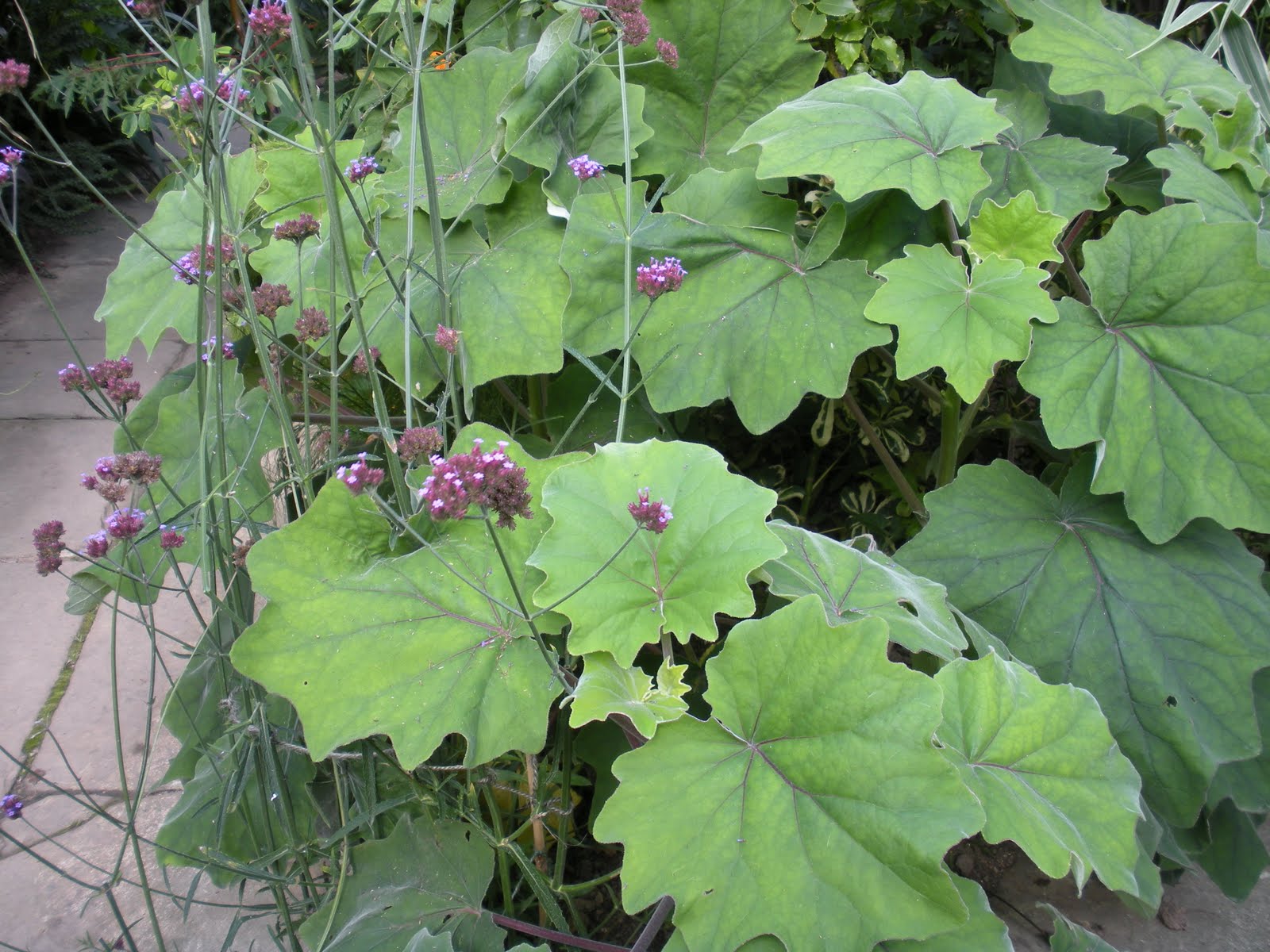
Amicia zygomeris - hardy perennial, left, with dramatic leaves in a kind of notched shape. Clusters of strange pea-like flowers from August to November. Cotswold Garden Flowers stock it, I see...

Euphorbia x pasteurii - glossy green euphorbia a bit like E. mellifera, with small honey-scented flowers. According to CGF, it has spectacular autumn colour as well.

Pennisetum glaucum 'Jade Princess' - fabulous ornamental millet with really exaggerated fluffy seed heads, like a group of brown cats' tails rising above broad, chartreuse leaves. I think Fergus said this was tender but a quick sleuth around the internet shows that it's on sale in the UK, with no warnings about frost protection. Hmm.

Will I buy all these plants? Probably not, but it's great to be inspired by so many things I've never seen before. I shall certainly pay the Great Dixter nursery a visit at the end of June, when they've planted out the exotic garden and have "leftovers" for sale.


A view of the Exotic Garden at Great Dixter. The plant with orange flowers in the foreground is a busy lizzie, similar to the jewelweed impatiens. On the right is an alocasia, sheltered by hardy bananas, and on the left, a yucca flower spike rises up in front of a clump of variegated arundo and a canna.

Here you can clearly see Fergus's layered effect, with dahlias, palms and taros (I think) growing beneath cannas and bananas. Through them, like coloured threads, scramble Verbena bonariensis and the firecracker flowers of Mina lobata. At ground level, there might be chlorophyum (spider plants) or glossy farfugium, or begonias or even dwarf conifers.
Phew. I think that's enough for now, don't you? I'll do a second post, in which I have a delicious lunch and learn how to split dahlias.

*I understand that Eupatorium capillifolium, or dog fennel, is a pernicious weed in some parts of America. In England, we grow it as an annual, and propagate it by cuttings. I love it as it gives height, but not bulk. But then there's absolutely no chance of it running amok in London...

Tuesday, August 31, 2010

Welcome to my garden, August 2010

To be honest, I found opening the garden for the National Gardens Scheme really tiring this year. I didn't sleep very well the night before and got up around 6.30am to make a cup of tea and feed the cat. Then my daughter drifted downstairs to say she had an ear infection and had been in pain all night. I drove her to the walk-in clinic at the nearby hospital, which luckily opens at 7am, even on Sundays. We got home, I settled her down with some antibiotic drops in her ear and went to "sit down for five minutes". Two hours later, I woke up in a major panic. It was 10am and I had four hours in which to ice 14 cakes, make two Victoria sponges, get out tables, chairs, cups, plates, notices, tickets, cash float, etc etc etc.
We managed to get ready in the nick of time, which was just as well, as when I went to open the gate, we had a queue of people waiting. Everyone said lovely things about the garden, but the weather decided to be rather spiteful and at about 3.30pm, we were treated to lashing rain and a howling gale.
We managed to get everyone inside, and after about half an hour, just as I was thinking we would have to have a sing-song or something to entertain everyone, the weather cleared. The day ended with a clear blue sky and bright sunshine, but the damage had been done and I think a lot of people had been put off.
The bloggers made a good show, though. I'd like to say a huge thank you to Emily and Ms B, and Rob and The Fat Gardener. I was so touched that you all came - it made my day.
In all, we had 92 visitors. At the time I was a bit disappointed - we had 166 last year - and I started to wonder whether all the hard work was worth it.
I think it was exhaustion that made me feel so negative, because after a day's rest I'm beginning to think we did pretty well, considering.
This morning, some workmen turned up to re-sand my living room floor, and they were so complimentary about the garden, that cheered me up too.
So I'll stop whingeing and let the garden speak for itself instead.

This is one of my favourite views. It's not a particularly attractive shot of the garden, but this is how it looked the morning after. It's the one day of the year when I can walk out into the garden and really revel in the knowledge that I don't have to do anything.

This is the front garden, looking strangely respectable. I decided I needed to tart it up a bit, since this is the first thing visitors see, so I've started using large cobbles to break up the expanse of gravel and I think it's working well. I'll do a separate post on it at a later date.

This is the first view visitors have of the back garden as they come down the side passage and turn the corner.

Opposite are the steamer chairs, inviting people to sit down and relax

This is a better overall view of the garden, taken in the afternoon, when the light is better.

Here's a closer view of the "hot border", with, from left, Ensete ventricosum 'Maurellii', (red banana), Fuchsia 'Thalia' (rescued by my neighbour from the dump), Cordyline 'Torbay Dazzler' and Canna 'Durban'. There are some people who will hate this combination and think it vulgar...

... but how could this not make your heart sing?

Here's another variegated canna, 'Pretoria', with more red bananas.

It's not all variegated foliage, though (as I'm sure James Alexander-Sinclair will be relieved to hear). Here's the Montezuma pine, whose extraordinary needles look at their best this time of year. They shimmer in the sun and in the rain, they look as if they are bedecked with thousands of tiny crystals.

The huge leaves of Tetrapanax papyrifera make a great foil for the extravagant fronds of the tree fern, Dicksonia antarctica

Oops, some more variegated leaves in the pond. This is Acorus gramineus 'Ogon', which is possibly the lowest-maintenance pond plant I have come across. In the centre is a white waterlily, 'Highlight', and the spiky things that look like submerged cordylines are water soldiers, Stratiotes aloides. Despite their exotic appearance, they are native to Britain and Europe.

Here's a view I don't often show you. This is the snow gum, Eucalyptus debeuzevillei, which comes from New South Wales. It's a great little tree - so much more delicate and user-friendly than the giant E. gunnii which seem to grow like weeds in London. This one has been stooled - ie cut right back when young - so it is multi-stemmed. I always think eucalyptus can look a bit drab, but this one looks wonderful with the sun on its pale bark.

Here's the pond known as the frog pond beneath the eucalyptus. The geranium is 'Rozanne', one of the most reliable hardy geraniums when it comes to summer-long flowering. It just goes on and on. The miniature bamboo is Pleioblastus auricomus and the heuchera on the left is 'Sweet Tea'.

This is the view from the bench you can see in the picture of the eucalyptus. I've tried to plan the garden so that wherever you sit down, there is something interesting to look at.
I hope you've enjoyed this mini-tour. If you want to read more about the National Gardens Scheme, Karen has a post about it here.

Blogging for Benjamin

One of the blogs I've followed almost from the moment I started my own is The Deep Middle, by Benjamin Vogt. Of those of us who contribute to the clamorous world of cybercommunication, he is more entitled than many to call himself a writer. He has a doctorate, he is a poet and author, and - of course - he is a gardener, architect of a gorgeous vision that his followers have seen develop from a bare backyard to a billowing mass of flowers that delights the soul and supports colonies of Monarch butterflies.
As you might expect from a poet, Benjamin feels passionately about things. I may not always agree with his views, but I never find his blog boring; it is always intriguing, challenging, enchanting. His comments on my blog are wry, funny and - in sad times - full of sympathy.
So I feel the least I can do is to join the chorus of publicity for his latest book, a poetry collection entitled Without Such Absence.
Indeed, mention of the book is long overdue on this blog, for the deadline to win a free copy is only two days away, on 3 September. You can also buy a copy, and pay only $1 shipping (I assume this is in mainland US only). My feeble excuse for this tardiness is my garden open day, which has taken up nearly all my spare time over the past few weeks.
So many apologies, Dr Vogt, and good luck.

Wednesday, August 25, 2010

Describe your garden in 50 words


It's raining here, so having racked my brains - not very hard, it must be said - for garden chores I can do in a steady downpour, I came inside for a cup of tea and a quick flick through The Garden, the monthly magazine of the Royal Horticultural Society, which arrived this morning.
One of the things I turn to first is Ursula Buchan's column, which this month mentions that it's time for all National Garden Scheme owners to fill in the application to open their gardens for next year.
"Much thought is given," says Ursula, "to the short description of the garden. How do you encapsulate so many years of planning triumphs, disasters, rethinks and incremental improvements in a few terse sentences?" Well, quite.
It's strange, but although I'm rarely at a loss for words when it comes to writing my blog, I find it very difficult to describe my garden. There are several problems.
First, I don't want to sound pompous, or pretentious, or boastful. Yet I do want to write something that will make people want to come and see it.
Second, one has to beware of mentioning features that may have disappeared - or reappeared - by next year. For example, I used to say I had three ponds, a big one and two little ones. (One visitor took issue with this, saying that two tubs of water hardly added up to one pond, let alone two.) However, this year, I have converted the less successful of the two small ponds into a kind of squelchy bog garden, with colocasias and a sarracenia. I only did it the other day, so although I'm very pleased with it, it's too early to say whether it is going to work in the long term. Next year, it may not be there.

The colocasias are 'Hawaiian Eye' (I think) and 'Blue Hawaii'. I can't tell you what the sarracenia is because the label is buried beside it and I didn't fancy dabbling around trying to retrieve it. Not with a camera in my hand, anyway.

At one point, my description used to mention a screen of Arundo donax, the tall Spanish reed, masking the trampoline from view. When I got rid of the trampoline, I forgot to edit this bit out, to the great disappointment of another visitor. (How can anyone look forward to seeing a trampoline?) I hope she doesn't come back this year, because I've ripped out most of the arundo as well...
Third - I can't think of a third. At the very thought of writing my garden description, my brain has begun to freeze over. How would you describe your garden? To make it even more challenging, we'll set a maximum length of 50 words.

Saturday, August 21, 2010

So what do I get out of it?


I'm in panic mode at the moment. I have a week to do all the gardening tasks that I've been promising myself I'll do for the past three months. (I can see at least two of them in the picture above: trim the box and deadhead the libertia.) And then there's the cakes. Oh, joy.
It's got to the point where people ask me if I'm opening my garden again. I hadn't really thought about this, beyond reflecting that it was sweet of them to take an interest, but I suppose it means that it is now established as an annual event, which is rather nice.
Lots of people also ask me what I get out of it, apart from raising money for charity, of course. There is a lot of work, about which I make a lot of fuss, and it would be silly to pretend that there weren't stressful or tiring moments. People say things like: "I suppose it must be nice when people come round and tell you your garden looks lovely."
Well, that's true, but what I most enjoy is seeing other people enjoy the garden. I was trying to explain this to a friend the other day and the best analogy I can come up with is this:
Imagine that you've gone out for the evening with friends, new or old, and at the end of the evening they say: "You look absolutely wonderful." That would be great, wouldn't it? But wouldn't you be even more pleased if they said: "We've had the most fantastic time, it was so lovely to see you again. We always enjoy going out with you so much."
I've never been sure whether I garden for an audience or not. I spend a lot of time alone in the garden, doing chores or just daydreaming, and I'm quite happy like that. The kids never notice anything new, particularly in the way of plants. It doesn't bother me: I don't drag them out to look at things.
My mother, on the other hand, says she finds gardening far more satisfying if someone comes round and admires the results.
I don't think I look for admiration, because if someone didn't like the garden, frankly, my dear, I wouldn't give a Darmera peltata. But I like it when the results give pleasure to someone else, which is slightly different, I think.
My husband used to enjoy the garden tremendously. He'd say nice things about what I'd done, sure, but what I liked most of all was the way he revelled in the discovery of the first ripe plum, or the appearance of the first flower or leaf on a treasured plant. I loved his enthusiasm.
I'd never thought about this before, but although I was quite keen on gardening before Craig and I got together, I didn't really have the courage of my horticultural convictions (such as they were) until we had our first garden as a couple.
In the same way that Craig gave me the confidence to be myself (he regarded my legendary bad temper as a vital tool for producing newspapers on time rather than as an acute personality defect), he gave me the confidence to garden for myself. If I'd said to him: "I think I might plant a huge cactus in the middle of the lawn," he wouldn't have looked disapproving and asked me if I really thought that was a good idea. He'd have just said: "How big a hole do you want me to dig?"
I miss him. Perhaps that enjoyment and enthusiasm is what I'm trying to recreate by opening the garden.

Friday, August 13, 2010

Open day: the information


A huge welcome to any Independent readers who have been directed here via my column today.
Here are the details of my open day for the National Gardens Scheme. Hope to see you there!