Showing posts with label birds. Show all posts

Tuesday, August 10, 2010

Woodpecker! A false alarm

I was idly looking out at the garden today when I saw a flash of red. Intrigued, I crept closer and saw a black and white bird with a red head sidle up the trunk of the Montezuma pine before launching itself at the fat ball feeder. A woodpecker!
But which woodpecker? I ran to the computer and called up the RSPB site. There are three woodpeckers found in the UK, the great spotted, the green and the lesser spotted. The great and lesser are quite similar except that the lesser spotted is smaller and has a distinctive red head.
Not only that, but while the great spotted is reasonably common, the lesser spotted is on the red list, ie globally threatened. OMG! Was this a lesser spotted?
I rang up the RSPB London branch (well, I had to tell someone) and agreed that I'd try to get a picture. I didn't hold out much hope, but the woodpecker seemed to have made a beeline - or perhaps that should be a woodpeckerline? - for the fat ball feeder, so it had obviously dined there before.
Sure enough, about a couple of hours later, there it was again on the trunk of the pine. This time I got a picture - and this time I could clearly see that it was a great spotted, with the distinctive white bar, like an upraised finger, on its side. Apparently, the juveniles have quite red heads and this is what had misled me.
Never mind. It's nice to see a woodpecker of whatever variety in the garden.

Sorry about the quality of the pictures - I had to take them through the glass as I didn't dare open the doors for fearing of scaring the bird away. Here's the red head that first attracted my attention.

The woodpecker seemed quite interested in the tree itself. The Montezuma has really thick, rugged bark and while I was trying to take these pictures, the bird kept disappearing for ages around the other side of the trunk.

Here's the bird side-on, and you can now clearly see the distinctive white shoulder patch.

It seems to be having a look at the seed feeder, but it didn't actually feed there. The fat ball feed is on the righthand side of the tree, out of shot.

The typical woodpecker pose. I've written before on this blog about feeding the birds all year round and as you can see, it certainly pays off.
Thursday, June 10, 2010

Fat, funny little birds

I feed the birds all year round in my garden. When we first moved in, seven years ago, there didn't seem to be any birds in the garden at all, which seemed strange as there are lots of mature trees.
Now the garden is alive with birdsong and although there is the odd casualty (thanks to Pushkin), I think on balance it's better to feed than not, even if you have a cat.
The conventional thinking used to be that you fed the birds in winter, when food was scarce. These days, evidence suggests - and it certainly seems to me - that birds appreciate a constant supply and flourish accordingly. However, even I used to scale down on the amount and variety of food available once the weather got warmer. It was only because I got a free packet of suet, or fat, balls with my bird food order the other day that I thought of hanging out fat balls at this time of year.
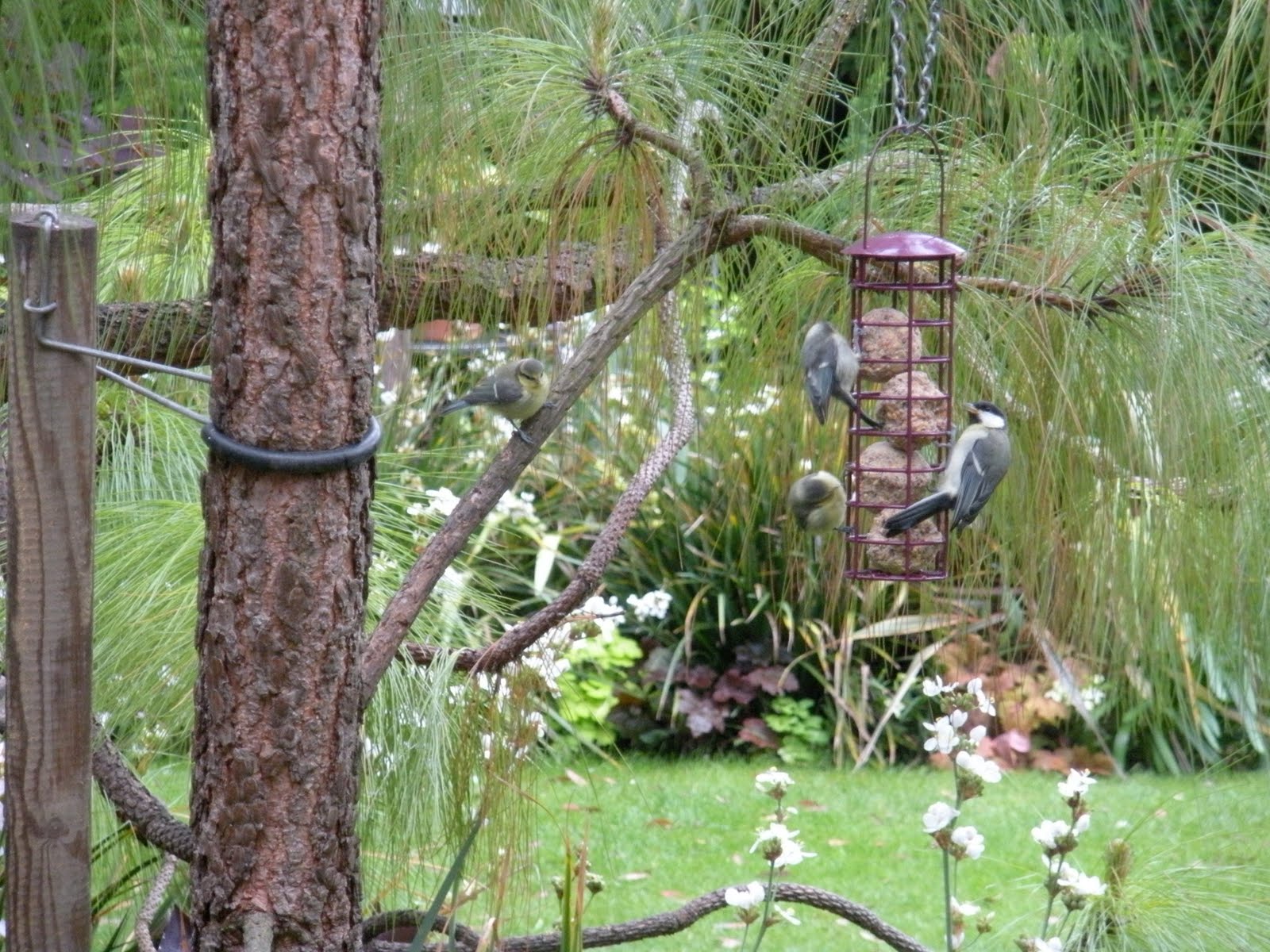
Goodness, what a revelation! The blue tits and great tits absolutely love them. They've abandoned the normal seed feeders and spend all their time hanging upside down and stuffing themselves. (Why don't birds get indigestion?)
They all have fledgelings to feed so dining out is a family affair. The fledgelings are just old enough to feed themselves, but it's still common to see a line of young ones (usually three or four) on a branch having food shoved into their mouths by their busy parents.
Very often, they perch on the branch above the fat feeder, but this morning I saw a row of little ones lined up precariously along a phormium leaf, which was bending under their weight. When a parent arrived with the takeaway, the leaf collapsed altogether and they all slid off the end. So funny!

The great tit family having breakfast. Sorry about the quality of the pictures - I don't have a tripod (or an incredibly good camera, come to that). There is also a blue tit family, so meal times are usually a blur of little birds rushing about. Underneath, (not in the picture) a fat woodpigeon struts to and fro as if he is on patrol, hoovering up crumbs.


Saturday, April 10, 2010

Goldfinch in my garden!

I didn't win anything on the Grand National today, but I did see a goldfinch in my garden this morning, which was far more of a thrill. The first one ever!
I'd been trying to encourage them with niger seed, but despaired of ever seeing anything other than greedy squirrels and greenfinches.
And then this morning, there he was, with his funny little clown face. He wasn't even eating niger seed, but just stuffing himself from the normal feeder.


The picture isn't mine, by the way. I was so excited, I would have dropped my camera.

Wednesday, June 24, 2009

Parakeets and phormiums

Ring-necked parakeets are an increasingly common sight in London. They first bred in the wild in the 1970s, in Esher, Surrey, but since then have spread north as far as Wimbledon and Wandsworth. You can see them (or probably hear them screeching first) if you visit Kew Gardens, or Syon Park, or Hampton Court, and apparently they can now be found as far as Yorkshire and Essex.
There is a legend that the first birds were released into the wild by Jimi Hendrix. Sadly, as far as I can ascertain, there is absolutely no truth in it. It's a lovely idea, though: kerrang!
Like most escapees, the parakeets are a bit of a nuisance. They compete with woodpeckers for nesting holes, and they can be noisy - they roost in flocks, like starlings. You can read what the Royal Society for the Protection of Birds thinks about their impact on the environment here.
However, they are also incredibly gorgeous. It still gives me a thrill to see them flashing across the garden, with their vivid green plumage and turquoise tails.
They've been visiting our bird feeders for the first time this year, possibly because of the cold winter - although according to the RSPB, they are often seen in London gardens. Even my daughter, who at 15 is usually too cool to react to anything, displayed a minuscule tremor of excitement when she spotted one.
The parakeets are quite shy and will scarper the minute they catch sight of a potential predator, which includes me and especially Pushkin who likes to lie doggo (or should that be catto?) under the phormium in the hope of catching birdlife unawares.

Excuse the blurry photos. I was trying to sneak a bit closer. There were two originally, like bookends, but one flew away.

He's really getting his beak stuck in there, isn't he? Greedy thing.

The blur on the right (click on the picture to get a better view) is a poor little great tit, who is desperately trying to snatch a bite for his supper. Every time he dived for the feeder, the parakeet snapped at him.

Still scoffing sunflower seeds. I couldn't get them in the picture, but underneath the feeder are a couple of woodpigeons, voraciously vaccuuming up any crumbs from the feast.

Here's Pushkin putting on his best sinister expression. You can almost hear him saying: "We've been expecting you, Mr Bond ..." (Look at the state of that grass. You can see how dry it has been in London.)

While we're on the subject of exotic things with beak-like protuberances, has anyone noticed that it seems to be a bumper year for phormium flowers? I've got loads - not just one or two spikes, as in previous years, but at least half a dozen per plant. They're strange-looking things: more like claws or beaks than flowers. The birds seem to like them though. Later in the summer we'll see blue tits eating the seeds. I like this. It's nice to see foreign imports making themselves at home and doing their bit for the community.

My attempt at a close-up of one of the flowers. They open up to reveal big black seeds.


Monday, March 23, 2009

The vanishing cuckoo

If you have a spare moment today - or even if you don't have a spare moment - make sure you read this. It's a terrifying yet lyrical article by my colleague Michael McCarthy, Environment Editor of The Independent, who has a new book out on 2 April charting the astonishing decline of England's songbirds.

Wednesday, May 7, 2008

Hello, Jack Sparrow


I saw a house sparrow in my garden today! This may seem like no big deal to some of you, but I haven't seen a sparrow in my garden for, ooh, 15 years. Recently, I've seen a couple on Wandsworth Common and hoped that the feeders in my garden and my neighbour's might attract them. The one I saw today was a male, but he had a friend with him who was hidden in the bamboo, so perhaps they'll both spread the word.
Three houses ago, I used to get crowds of sparrows in the garden, but in those days I lived in a big Victorian house with lots of ivy growing up the back wall. Next door had lots of ivy as well, which acted as a kind of sparrow tenement block. I'm convinced the fashion for ripping climbers off walls and stripping gardens of all vegetation in the attempt to turn them into "outside rooms" is partly to blame for the demise of the London sparrow population. People say climbers like ivy are bad for walls. I say bare walls are bad for sparrows.