Saturday, October 23, 2010

Getting high with the king of grass

I spent last week in New York City. I'd promised my daughter ages ago that I'd take her there for her 16th birthday. Unfortunately, she was doing exams at the time of her actual birthday, so I suggested we go during October half-term (when, incidentally, it was also my birthday). We spent most of the time shopping, and eating, and shopping, and going to the theatre, and, erm, doing yet more shopping. It was fabulous.
I knew that the merest hint of garden visiting would not be popular with my daughter. However, I asked Alice at Bay Area Tendrils if there was anything she'd particularly recommend (she travels a lot) and she suggested the Highline, in the Meatpacking District. Of course! How could I have forgotten about the Highline?
Better still, said Alice, there were some very groovy designer shops in the neighbourhood, with which to lure my daughter. Perfect.
For those who don't know, the Highline is a disused railroad on the West Side of Manhattan. It was built in the 1930s to carry freight, but no trains have run on it since 1980. Property developers began eyeing it up in the 1980s but thanks to a vociferous local campaign it was saved and in 2006, work began on the task of turning it into an elevated public park. (You can read the whole story on the website.)
It begins at Gansevoort Street and extends as far as 34th Street, but only the section between Gansevoort and 20th has been completed. The second section is under construction, but the first opened to the public in June last year and in my opinion, it is one of the most delightful and imaginative public landscaping schemes I have ever seen.
The planting design is by Piet Oudolf, the Dutch landscaper whose speciality is so-called prairie planting. The overall effect is of a wild space, dominated by grasses and trees such as sumac and airy birches. At first glance, it looks just like the sort of landscape you would find on any old disused railroad, but the addition of rudbeckias, asters and coneflowers, and the contrasting heights and textures of the plants tell you that here is a master at work.


One of the plants I particularly liked was the thread-leaf bluestar, Amsonia hubrichtii. You can see its golden spires beside the lounger on the left.

Although the Highline is a continuous walkway, each section has its own distinct personality. We joined it at the Gansevoort Stair, and walked north through the Gansevoort Woodlands, marvelling at the way the original railroad tracks have been incorporated into the design.
The paths are not straight - and neither are the tracks - but follow a sort of slalom, intensifying the impression of a woodland or country park walk and forming a very pleasing contrast to the Manhattan street grid below.
Just under halfway along is a sundeck, where huge loungers have been constructed. Couples can cosy up on a sunbed for two, while more solitary types can read in peace on a solo version.


As well as the sumacs (Rhus typhina and Rhus glabra) which are showing off at this time of year in their autumn reds, trees include birches, serviceberries (amelanchier to British readers) and three-flower maples (Acer triflorum). Here, trees frame a view of Ellis Island and the Statue of Liberty. The low-growing grass is Nassella tenuissima, or Stipa tenuissima as we know it in the UK.

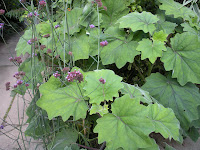
In autumn, the grasses are the stars of this off-Broadway show. There are so many of them - Panicum virgatum 'Shenandoah'; Sporobolus heterolepis; Bouteloua curtipendula; Calamagrostis brachytricha. Nestled among them to provide textural variety are Heuchera villosa 'Autumn Bride' and Sedum telephium 'Red Cauli' - a Piet Oudolf favourite.

So what did my daughter think of Mr Oudolf's masterpiece? Was she blown away?
"It's grass, Mum," she said. "Get over it."

Sunday, October 10, 2010

Just because ...

The sun is shining ...

... and this Virginia creeper looks so pretty (even though it has absolutely no business climbing up the bamboo)

... and I love the pattern of the sunlight on the lawn

... and the fact that the containers are still full of colour

... and flowers and foliage

... and the way the terracotta pots glow in the afternoon sun.
But really, who needs an excuse?

Thursday, September 30, 2010

Ideas for Adrian's garden

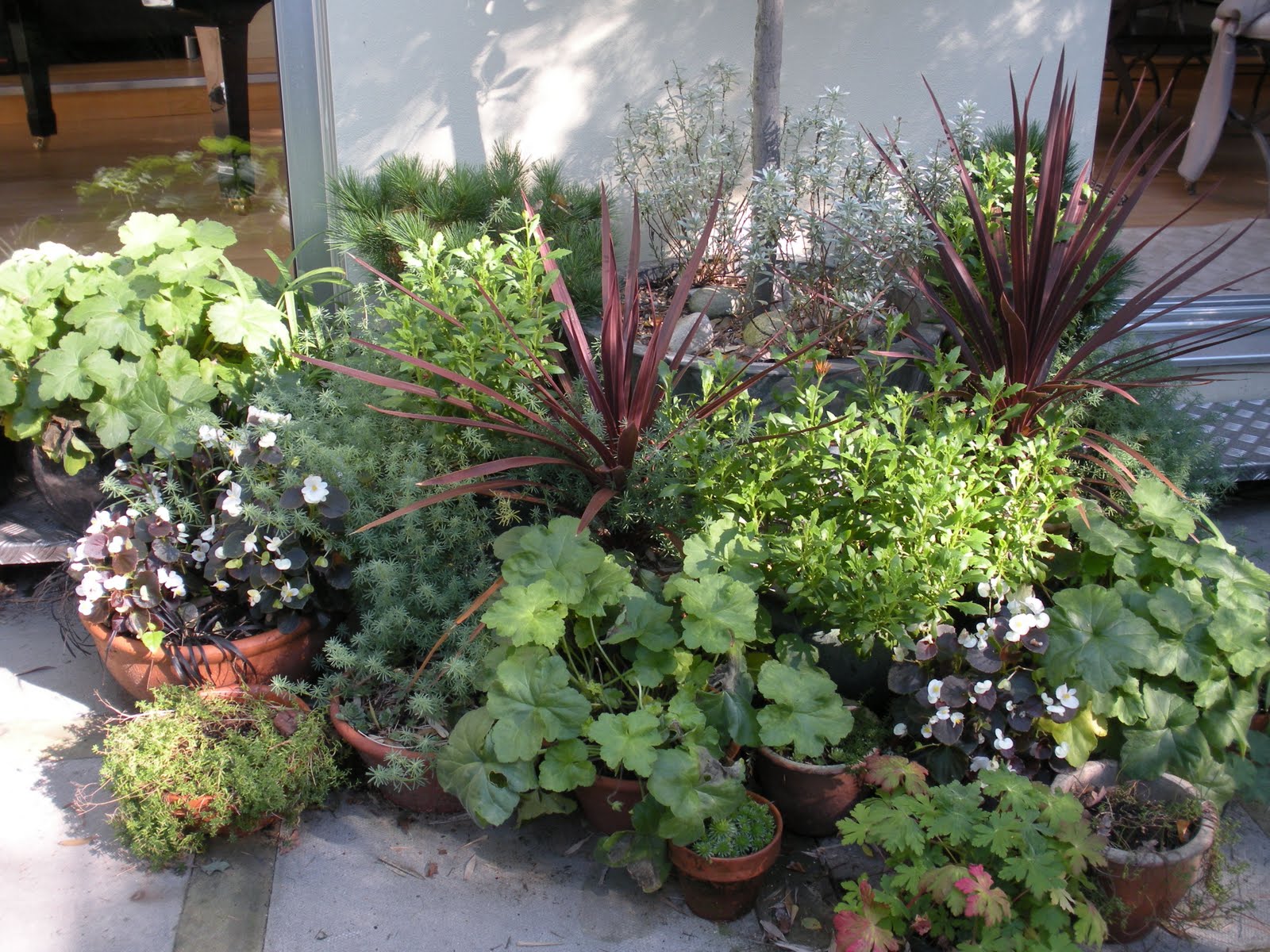
My colleague Adrian, like many Londoners, has a small garden - a shady, brick-paved courtyard. (That's not his on the left, by the way, but belongs to my friend Philip, whose garden in Homerton is in the Yellow Book.) Like many journalists, Adrian works long hours, and he would like to come home on a summer evening and be able to spend what is left of his day breathing in the fragrance of flowers. I think this is a lovely idea, and I also think he ought to try to find white scented flowers, as they will not only provide perfume, but be easier to see at dusk.
My suggestions included Trachelospermum jasminoides, known as star jasmine (or Confederate jasmine in the USA). This will survive quite happily in a big pot and as well as white fragrant flowers has the bonus of glossy evergreen leaves. Admittedly, it doesn't flower as freely in shade as it does in sun, but the screen of green leaves is worth having anyway.
Nicotiana is a must. I find N.affinis does well in pots and seems to be more snail-resistant than N. sylvestris. Adrian might also like to try the F1 Perfume series, which are smaller, but very reliable. The pale lime ones look good with white.
Lilies are a must and all seem to do well in pots. L. regale has a knockout perfume but in my experience is more susceptible to lily beetle. Perhaps Adrian could go on a lily beetle hunt of an evening, squishing the little red b****** while pretending they were a particularly uncooperative, late-filing contributor. Very therapeutic.
The new varieties of nemesia have wonderful scent. N ‘Wisley Vanilla’ makes a wonderful mound of ice-cream scented flowers. And although busy lizzies aren't scented, they are perfect for shade and good at providing pools of white at twilight. The 'New Guinea' ones have bigger flowers and more interesting foliage.
I think people often underestimate the importance of foliage in gardens in their feverish search for flowers. Personally, I'd have lots of hostas, and perhaps Japanese maples and ferns, which will all survive in pots. I'd probably have a fatsia, too, or a choisya, again to provide year-round evergreen interest. In my opinion, as you can see from the photograph of Philip's garden above, a lush green background is far more restful than a blank wall and offers a real sense of sanctuary from the world.
A water feature - perhaps one of those overflowing pot versions with moving water that won't allow mosquitoes or midges to breed - provides a restful background noise which distracts from traffic and aeroplanes. Here's the water feature in Philip's garden, which is simply a ceramic bowl with a wall spitter connected up to a pump. All the boring bits like pipes and wiring are hidden behind the surrounding pots of hosta and zantedeschia, and large cobbles.


Anyway, these are just off the top of my head ideas. What I'd like - and what Adrian wants - is lots and lots of suggestions. So get thinking - and commenting!

Saturday, September 25, 2010

An Exotic day at Great Dixter: Part II

Lunch at Great Dixter was cheese tart, with green salad leaves and Pink Fir Apple potatoes, those knobbly ones that look a bit like Jerusalem artichokes. The potatoes were full of flavour and the texture was just right - waxy, but not too hard. The cheese tart, I felt, was imbued with the spirit of Christopher Lloyd. Like Christo himself, it had no truck with political correctness or calorie-counting or anything soppy like that. It was very, very tasty. Pudding was gooey chocolate brownies with freshly sliced oranges.
As you'd expect with a study day on exotics, most of the students were men. There were some women there, but only two of us appeared to be as passionate about the subject as the blokes. There's something about boys and big leaves.
Everyone was very friendly, though, and conversation over the lunch table centred around winter losses (everyone seemed to have lost hardy bananas this winter) and canna virus. (Fergus had explained that Great Dixter no longer brought in any cannas from outside nurseries in an attempt to eradicate this disease.)
The afternoon activities began with a tour of the cellars and greenhouses. Fergus explained that all the cannas and dahlias were lifted and stored in the cellars, which aren't heated but whose thick walls provide adequate frost protection. The rhizomes are packed in old compost in boxes or containers (Fergus recommends those expanded polystyrene fish boxes, which give even more protection against cold). They are watered once a month, just to stop them drying out completely.

The cellars are also used to store potatoes - here are the delicious Pink Fir Apples we had for lunch.

From the cellars, we went to the greenhouses, where the plants from the Exotic Garden are stored in winter. "Emergency supplies" are also kept there, to be brought out when gaps appear later in the season or when a plant is damaged.

Some of the greenhouses are heated, some are not. The latest one is sunk about three feet below ground level, partly so that the earth itself provides insulation and partly because Christo didn't want to see the greenhouses from the house! (They're very nice greenhouses: I wouldn't mind looking at them.)
Fergus showed us how to propagate ferns from spores. You look at the back of a frond to see if the spores are ripe (ie when they turn dark) and then leave the frond on a piece of paper to dry out. The spores will drop, whereupon you can sprinkle them on the top of a pot filled with well-watered compost. Wrap a polythene bag around the top of the pot and leave to germinate in a warm place. He made it look dead simple, but I bet it's not...
Then we had a mini seminar on splitting dahlias. This also looked simple: the trick, said Fergus, was to pull off some of the "collar" with each piece of rhizome. He managed to transform a big dahlia in what looked like a 9inch pot into nine new plants.
Cannas could be treated even more roughly. Just look for the growing points and cut in between them, using a sharp carving knife or breadknife. (I know this is simple: I've done it. In fact, I didn't even look for the growing points, but just slashed straight down between the stems.) Remember to do this in spring, when the plants will grow away well. It's easy to see the growing points then too.

Finally, snitching an apple from a nearby tree (what a fantastic year it's been for fruit here in the UK), we arrived at the Exotic Garden.

The enormous leaves of Tetrapanax papyrifera 'Rex' - known in our household as T Rex

A stooled paulownia spreads its vast leaves against the sky

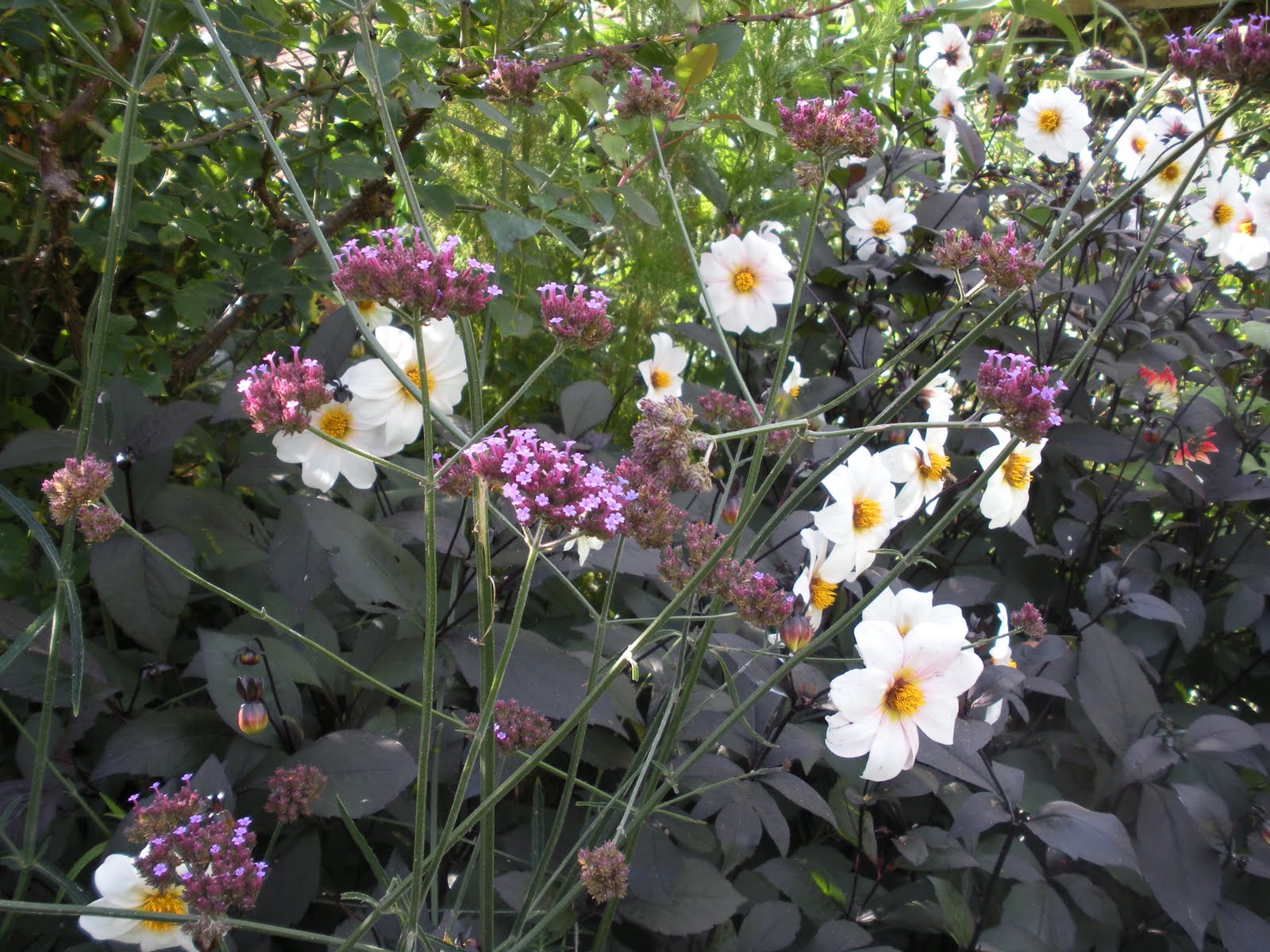
Mina lobata, or the firecracker vine, scrambles through cannas and Verbena bonariensis

Dahlias!

More dahlias!

Even more dahlias!

Yet more dahlias!

And some more dahlias. I must apologise for not noting down the varieties. But after a bit, my head began to spin ...

Ah, I know this one. This is (not a very good picture of) Dahlia 'David Howard'

And so, our notebooks full and our heads buzzing with information, we left Great Dixter via the nursery. But I couldn't go before one last wander round the gardens.


Wednesday, September 22, 2010

An Exotic day at Great Dixter

It's been a busy weekend. First, I spent Friday in Oxford with my daughter. It was the university's open day, so we were looking at colleges and going to various presentations on a preliminary fact-finding mission - she won't apply until next year.
Saturday, having dropped daughter at home, I went back to Oxfordshire, to Woodstock to have lunch with friends and see their garden. (Gorgeous, but I forgot my camera.)
Sunday, I was at the Woodstock Literary Festival, held at Blenheim Palace, where I was interviewing Helena Attlee about her new book, Italy's Private Gardens. I'd been a bit nervous about it, but in retrospect, that seems silly because it was a dream assignment. The book is absolutely mouth-watering and Helena has an endless supply of stories and anecdotes, all equally fascinating, about her experiences and the people she met along the way. VP was there, and you can read all about it on her blog.
I hadn't intended to have such a busy time, because months ago I had signed up to do a study day at Great Dixter on exotic plants. Monday was the day, and here I was - knackered! I'd driven home down the M40 on Sunday in the usual bumper-to-bumper Sunday night traffic, and then set off for East Sussex (another two-hour drive) first thing Monday morning.
It is a huge tribute to Great Dixter head gardener Fergus Garrett's lecturing skills that I did not fall asleep during the first session.
I arrived at Dixter at about 9.45am. It was a chilly, misty morning so I was delighted to be welcomed with a cup of tea in the Great Hall. Outside, the air smelt of autumn - damp leaves, wet earth and the seductive scent of woodsmoke.
We were ushered into the Benenden Hall, where the source of the woodsmoke turned out to be a truly baronial fire. Packs were provided for each student which included a list of slides and - hurray - a pencil. (Like most journalists, I never seem to have a pen when I need one.)
Fergus ran through the day's events. There would be slides and a lecture all morning, with a break for coffee, then lunch. After lunch, there would be a tour of the garden, including the glasshouses and cellars, followed by a detailed look at the Exotic Garden, and a practical demonstration. This would be followed by tea and a chance to buy plants.
I loved Fergus's lecture. He told us about the beginning of exotic planting at Dixter, and how he and Christopher Lloyd had been inspired by a range of influences, including the work of Dan Benarcik at the Chanticleer gardens near Philadelphia. Another inspiration was Ray Waite, the former superintendent of glasshouses at RHS Wisley, in Surrey.
Christo, said Fergus, wanted to take people "closer to the Equator", while he liked the idea of leading people into a Rousseau painting.
Next came the plants. Slide after slide of alluring specimens appeared, while my pencil raced across the page, ringing names and scribbling notes. If I tell you there were 326 slides in total, I'll probably put you off going on a study day at Dixter. But the lecture was so carefully structured that it didn't seem at all indigestible.
Fergus seemed to speak without notes (I didn't see any, anyway) and in a very informal manner, so while there was a definite logic to the sequence of slides (inspiration, plants, design philosophy, how to focus on a particular season, pruning, winter care and so on), these were sprinkled, like a glorious pot-pourri, with nuggets of advice.
In my notebook, there are instructions such as "Stool pawlonia in spring" and "Grasses don't like autumn disturbance" and "Never split dahlias and cannas in autumn" alongside observations such as "Christo thought Dahlia 'David Howard' was the best dahlia ever produced" (I agree!).
Supplementing these are comments such as: "'David Howard' looks good with white cosmos and Eupatorium capillifolium*" and "Label dahlias and cannas before the frosts hit the leaves, or you'll never remember which is which."
Fergus's design philosophy was wonderfully unpompous. All he was trying to do, he said, was to create a sub-tropical scene and if that meant including dwarf conifers, whose quirky character, he felt, fitted that space, then that was fine.
His major concerns were scale, and texture, and shape. Broad leaves should be balanced by feathery fronds and tall fountains of grasses and palms. Dark foliage should contrast with light, bright colours and vice versa. Plants should be "connected", so that tall specimens such as cannas should be the grand finale above a crescendo of planting, rather than suddenly erupting from a low carpet of bedding such as you see in the conventional public park-style designs.
It was wonderful to hear all this set out in a lecture. This is exactly the sort of thing that I try to do in my garden, and I found myself constantly nodding in agreement, much to the amusement of the man sitting next to me.
As someone who has a semi-sub-tropical garden, I was quite familiar with some of the plants. There were many others, however, I'd never seen before, and lots that I don't grow.
Here's a list of the plants I coveted. Many are tender, which means they're impractical for me as I don't have a greenhouse. I'm determined to get my hands on anything that's hardy, though!
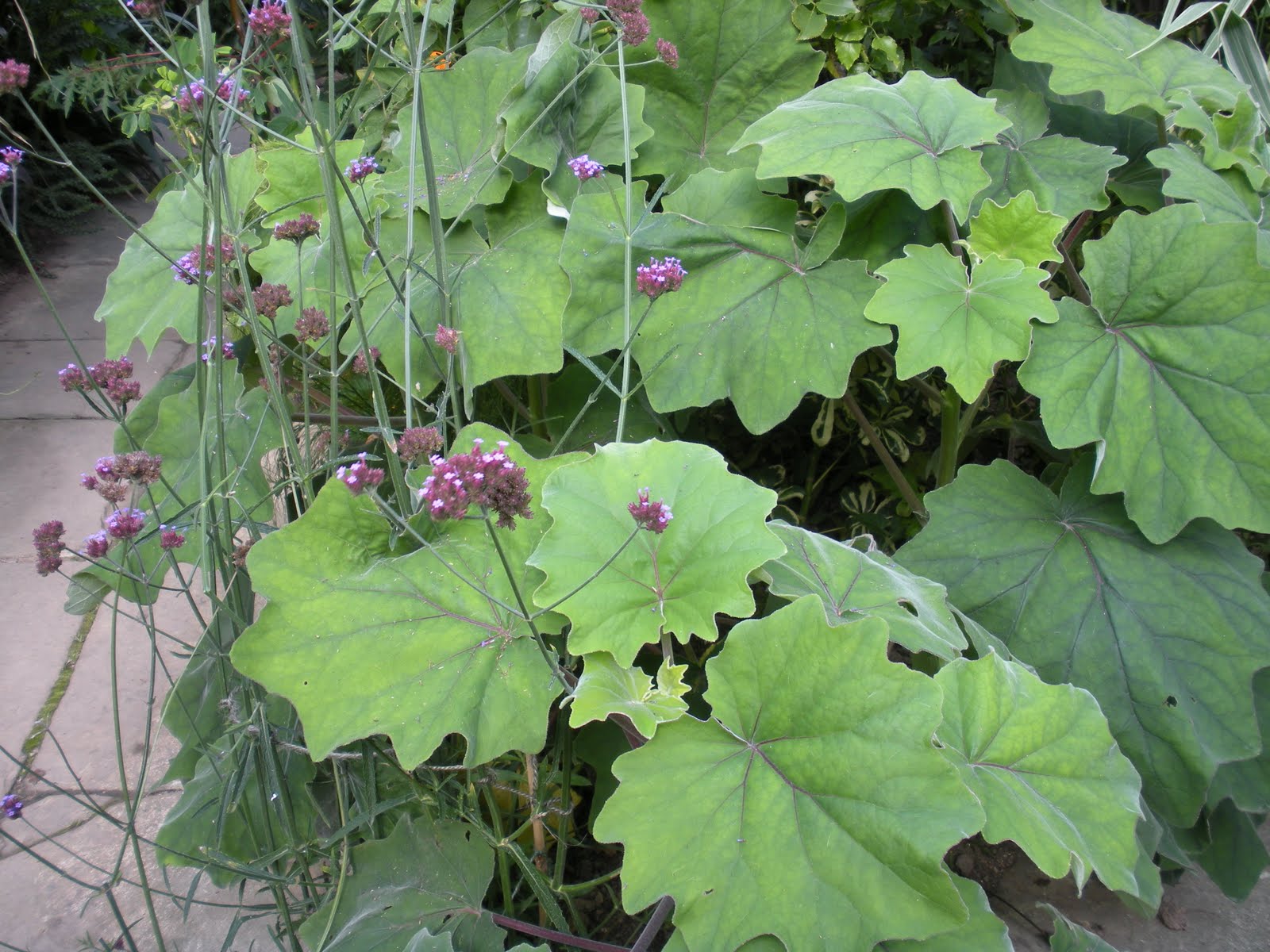
Senecio petasitis - low-growing shrub (pictured left) with wonderful, big, round, green-grey woolly leaves. Tender.

Euphorbia cotinifolia - a euphorbia that looks like a cotinus, but without the height and width issues. Tender.

Manihot grahamii - tropical shrub that looks a bit like a schefflera, but with more exotically shaped leaves. Tender, tricky and rare.

Salvia confertifolia - wonderful big shrubby salvia (left) with red, velvety flower spikes the colour and texture of antique theatre curtains. Tender, which is sad because I absolutely love it. I'm tempted to push the envelope with this one. What is it they call it in the States? "Zonal denial"? I know just how that feels.

Arundo donax versicolor - a yellow variegated version of arundo. Looks fantastic popping up between cannas. Hardy. Yay!

Begonia luxurians - I have only ever seen this begonia, also known as the Palm Leaf Begonia, on sale at Dixter. It grows quite big, about 6ft, with leaves like slender green hands, and bears small white flowers.

Amicia zygomeris - hardy perennial, left, with dramatic leaves in a kind of notched shape. Clusters of strange pea-like flowers from August to November. Cotswold Garden Flowers stock it, I see...

Euphorbia x pasteurii - glossy green euphorbia a bit like E. mellifera, with small honey-scented flowers. According to CGF, it has spectacular autumn colour as well.

Pennisetum glaucum 'Jade Princess' - fabulous ornamental millet with really exaggerated fluffy seed heads, like a group of brown cats' tails rising above broad, chartreuse leaves. I think Fergus said this was tender but a quick sleuth around the internet shows that it's on sale in the UK, with no warnings about frost protection. Hmm.

Will I buy all these plants? Probably not, but it's great to be inspired by so many things I've never seen before. I shall certainly pay the Great Dixter nursery a visit at the end of June, when they've planted out the exotic garden and have "leftovers" for sale.


A view of the Exotic Garden at Great Dixter. The plant with orange flowers in the foreground is a busy lizzie, similar to the jewelweed impatiens. On the right is an alocasia, sheltered by hardy bananas, and on the left, a yucca flower spike rises up in front of a clump of variegated arundo and a canna.

Here you can clearly see Fergus's layered effect, with dahlias, palms and taros (I think) growing beneath cannas and bananas. Through them, like coloured threads, scramble Verbena bonariensis and the firecracker flowers of Mina lobata. At ground level, there might be chlorophyum (spider plants) or glossy farfugium, or begonias or even dwarf conifers.
Phew. I think that's enough for now, don't you? I'll do a second post, in which I have a delicious lunch and learn how to split dahlias.

*I understand that Eupatorium capillifolium, or dog fennel, is a pernicious weed in some parts of America. In England, we grow it as an annual, and propagate it by cuttings. I love it as it gives height, but not bulk. But then there's absolutely no chance of it running amok in London...

Tuesday, August 31, 2010

Welcome to my garden, August 2010

To be honest, I found opening the garden for the National Gardens Scheme really tiring this year. I didn't sleep very well the night before and got up around 6.30am to make a cup of tea and feed the cat. Then my daughter drifted downstairs to say she had an ear infection and had been in pain all night. I drove her to the walk-in clinic at the nearby hospital, which luckily opens at 7am, even on Sundays. We got home, I settled her down with some antibiotic drops in her ear and went to "sit down for five minutes". Two hours later, I woke up in a major panic. It was 10am and I had four hours in which to ice 14 cakes, make two Victoria sponges, get out tables, chairs, cups, plates, notices, tickets, cash float, etc etc etc.
We managed to get ready in the nick of time, which was just as well, as when I went to open the gate, we had a queue of people waiting. Everyone said lovely things about the garden, but the weather decided to be rather spiteful and at about 3.30pm, we were treated to lashing rain and a howling gale.
We managed to get everyone inside, and after about half an hour, just as I was thinking we would have to have a sing-song or something to entertain everyone, the weather cleared. The day ended with a clear blue sky and bright sunshine, but the damage had been done and I think a lot of people had been put off.
The bloggers made a good show, though. I'd like to say a huge thank you to Emily and Ms B, and Rob and The Fat Gardener. I was so touched that you all came - it made my day.
In all, we had 92 visitors. At the time I was a bit disappointed - we had 166 last year - and I started to wonder whether all the hard work was worth it.
I think it was exhaustion that made me feel so negative, because after a day's rest I'm beginning to think we did pretty well, considering.
This morning, some workmen turned up to re-sand my living room floor, and they were so complimentary about the garden, that cheered me up too.
So I'll stop whingeing and let the garden speak for itself instead.

This is one of my favourite views. It's not a particularly attractive shot of the garden, but this is how it looked the morning after. It's the one day of the year when I can walk out into the garden and really revel in the knowledge that I don't have to do anything.

This is the front garden, looking strangely respectable. I decided I needed to tart it up a bit, since this is the first thing visitors see, so I've started using large cobbles to break up the expanse of gravel and I think it's working well. I'll do a separate post on it at a later date.

This is the first view visitors have of the back garden as they come down the side passage and turn the corner.

Opposite are the steamer chairs, inviting people to sit down and relax

This is a better overall view of the garden, taken in the afternoon, when the light is better.

Here's a closer view of the "hot border", with, from left, Ensete ventricosum 'Maurellii', (red banana), Fuchsia 'Thalia' (rescued by my neighbour from the dump), Cordyline 'Torbay Dazzler' and Canna 'Durban'. There are some people who will hate this combination and think it vulgar...

... but how could this not make your heart sing?

Here's another variegated canna, 'Pretoria', with more red bananas.

It's not all variegated foliage, though (as I'm sure James Alexander-Sinclair will be relieved to hear). Here's the Montezuma pine, whose extraordinary needles look at their best this time of year. They shimmer in the sun and in the rain, they look as if they are bedecked with thousands of tiny crystals.

The huge leaves of Tetrapanax papyrifera make a great foil for the extravagant fronds of the tree fern, Dicksonia antarctica

Oops, some more variegated leaves in the pond. This is Acorus gramineus 'Ogon', which is possibly the lowest-maintenance pond plant I have come across. In the centre is a white waterlily, 'Highlight', and the spiky things that look like submerged cordylines are water soldiers, Stratiotes aloides. Despite their exotic appearance, they are native to Britain and Europe.

Here's a view I don't often show you. This is the snow gum, Eucalyptus debeuzevillei, which comes from New South Wales. It's a great little tree - so much more delicate and user-friendly than the giant E. gunnii which seem to grow like weeds in London. This one has been stooled - ie cut right back when young - so it is multi-stemmed. I always think eucalyptus can look a bit drab, but this one looks wonderful with the sun on its pale bark.

Here's the pond known as the frog pond beneath the eucalyptus. The geranium is 'Rozanne', one of the most reliable hardy geraniums when it comes to summer-long flowering. It just goes on and on. The miniature bamboo is Pleioblastus auricomus and the heuchera on the left is 'Sweet Tea'.

This is the view from the bench you can see in the picture of the eucalyptus. I've tried to plan the garden so that wherever you sit down, there is something interesting to look at.
I hope you've enjoyed this mini-tour. If you want to read more about the National Gardens Scheme, Karen has a post about it here.