Tuesday, April 19, 2011

Colour me beautiful

I'm useless with colour. I'm not one of those people who can unerringly point to the hue that is just right for the living room/bedroom/garden furniture. If I'm having any remodelling done, I ask the decorator, Ralph, to choose a colour. I'm serious - he has good taste, and it saves me hours of dithering over paint charts.
I know lots of gardeners who are good with colour - who paint their trellis, their shed or their front door just the right shade of greige, or sea-blue, or dark green. Oregon gardener Grace Peterson has a header picture on her blog that includes a cherry-red trellis which looks gorgeous. I hanker after colour too - but I'm too much of a scaredy cat to commit myself with a brush. The most I've ever done is paint a couple of seed trays (below) - and let's face it, that's hardly Sistine Chapel level.

Indeed, merely painting the seeds trays involved hours of dithering over the Cuprinol Garden Shades range in the local DIY store. The colour is Seagrass, and I can't remember why I chose it. I was initially drawn to Sunflower, but thought it might look like raw yellow wood, rather than yellow paint. This also put me off using Terracotta, Berry and Deep Russet, as I thought it would end up looking New Fence colour.
I did think of mixing colours - Country Cream with Sunflower, to get a pale creamy yellow - but chickened out. I thought it might look a bit Country Living as opposed to Urban Jungle.
I don't like blue, so that ruled out Barleywood, Iris and Forget Me Not. And I'm not really a Lavender person, though I can see it might look very pretty in some gardens.
So what do YOU think? If I were to paint the bird table below, which I have often thought of doing, what shade should it be? Should I go back to Sunflower? Or should it be Seagrass, like the seed trays? And whatever colour I paint it, should I paint my old garden bench to match? I'd like something that looked vaguely Oriental, or Caribbean, rather than shabby chic. Or should I just leave it?
Can't wait to hear your thoughts.

Saturday, April 16, 2011

A paradise for plantaholics


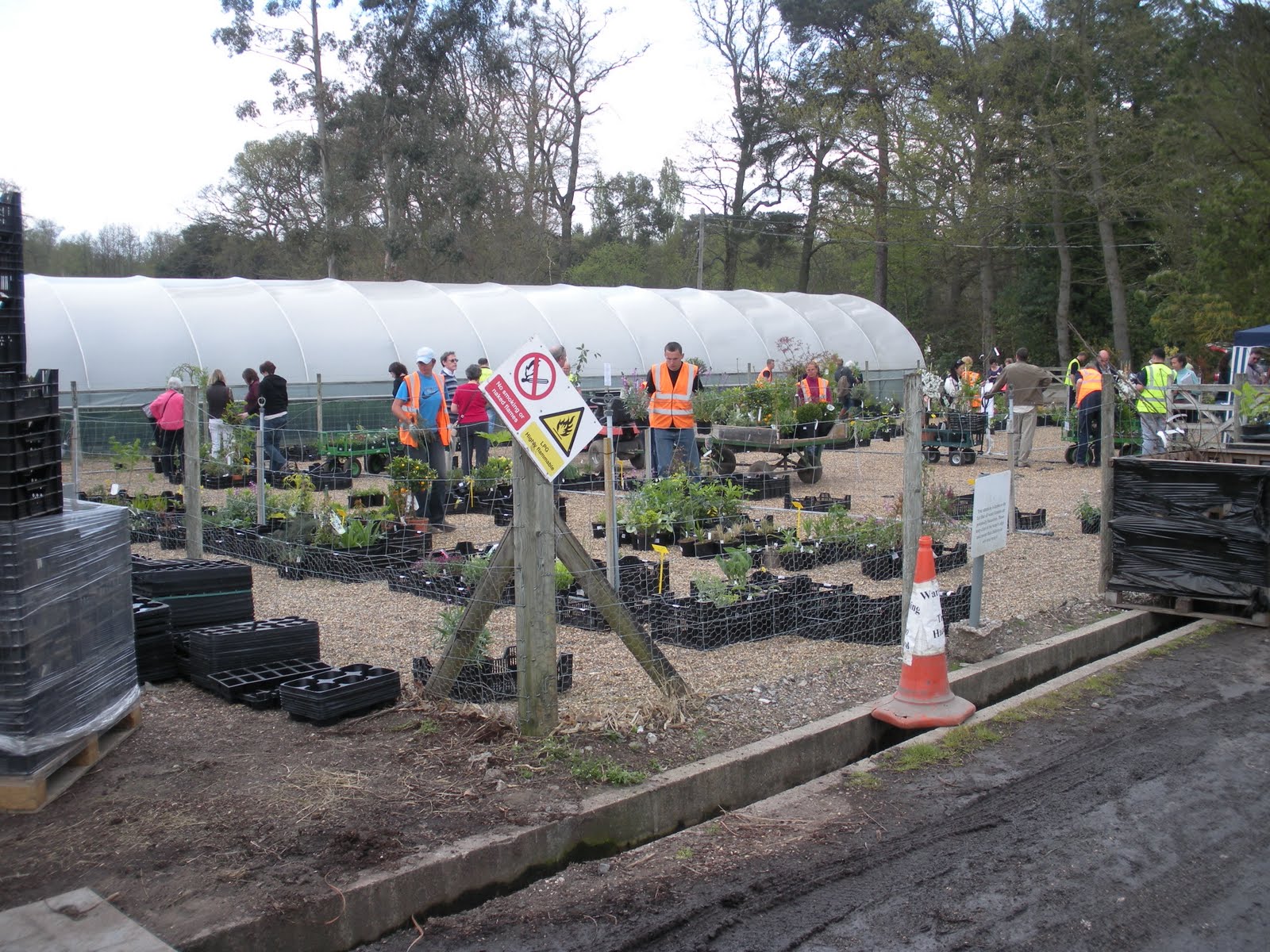
Open day at Crocus, who must by now be the UK's biggest online nursery. They have a real nursery, as well as a virtual one, just outside Windlesham in Surrey, and today they flung open their polytunnel doors to the general public.
Crocus also supplies many of the Chelsea show gardens, and were offering tours so you could see what plants were being grown. My neighbour Ruth and I had fully intended to go on one of these tours, but from the moment we arrived, we were far too interested in shopping for ourselves than to go and look at other people's choices.

It was the first time either of us had been to a Crocus open day, and we were very impressed by the organisation. When you arrive, you are given an explanatory leaflet with a guide to the prices, and a couple of strips of stickers with your number on it.
As you go round the nursery, you pick up any plants you want, put a sticker on them and leave them in the aisle, where they are picked up by helpers. These are then loaded onto trailers and taken back to the central payment point, where your collection of plants is held under your number until you want to pay.
It sounds a bit haphazard, but it works - it means that you don't have to carry the plants round with you, and there isn't a traffic jam of garden centre trolleys everywhere. Brilliant.
If I had to make any criticism at all, it would be that it was quite difficult to find someone who knew about the plants. Most of what I assume were temporary staff brought in for the day seemed to be Polish and spoke little English. However, they were so eager to help, and so charming, that it seems churlish even to mention this.
In any case, there were loads of knowledgeable customers around. The only plant I drew a complete blank on was Asphodeline liburnica. No one seemed to have heard of it, but its feathery stems were so extraordinary, that this didn't stop anyone buying it.

Areas that were out of bounds for various reasons - customer orders, Chelsea plants etc - were clearly marked.

The quality of the plants was fantastic, as was the range available. The Crocus website has a "wish list" feature which, in my case, always runs to at least a dozen plants. Ruth, who is more organised than me, had actually printed out her wish list and brought it with her. How many times have you visited a nursery or garden centre only to find that they haven't got what you want? At Crocus, I got everything.

One of the tractor-trailers bears its load back to the central payment point, below. Someone then totted up your total - so you didn't have to unload and load up all the plants again - then gave you a slip of paper to take to the till.

The prices, by London standards, were amazing. A typical 2-litre perennial, normally something like £7.99 or £8.99 or even more in a London garden centre, cost £5. I bought something like 15 plants for £80, which included a Trachelospermum jasminoides, on special offer at £12.50 (usual price £24.99). Ruth bought a tangerine and a lemon tree, which were on special offer at £20 each. They were fantastic plants, too - bushy and glossy and green.
Ruth and I arrived at about 11am and by the time we left, it was 2.15pm. We were exhausted but very happy - we both agreed it was one of the best day's plant shopping we'd ever had. Crocus are having three more open days, and you can get the details here. It's well worth a trip.

Friday, April 15, 2011

A day at Loseley with Zoe


Loseley Park is an Elizabethan (1562) manor house just south of Guildford, near Godalming, and about 45 minutes drive from me. It's on the edge of the North Downs, where the air is clear and sweet and smells of grass and trees.
The walled gardens are not particularly well-known by great English garden standards, but they are definitely worth a visit. They are a blend of formal yew hedges and cottage garden sprawl that is traditionally English and very restful.
Nothing is staked within an inch of its life as in more formal gardens - plants are allowed to seed around. The herb garden in particular is beautiful at this time of the year, with huge drifts of sweet cicely, woodruff and the bright new foliage of angelica.
The picture above shows the rose garden - astonishingly green at this time of the year, and rather attractive, in a stark sort of way. Below, the huge lime-yellow heads of Euphorbia characias subs. wulfenii act as pointers to the spring garden, where forget-me-nots, tulips and wallflowers run amok beneath pleached fruit trees.


I didn't notice the patterns on the bark of the fruit trees until I uploaded the photographs. But I loved the combination of the brilliant cherry red tulips and the ornamental rhubarb.


I'd gone to Loseley to meet Zoë, and to have a mooch around their spring garden show. This was held in the walled gardens themselves, which was a lovely setting. The stalls included plants, garden bygones, secondhand tools and furniture, but I have to confess that we spent most of our time sitting chatting.
I'd turned up with no cash, which I thought would stop me buying stuff. This ploy did not work. I bought two all-weather rattan garden chairs on my credit card (well, I had to have that to buy petrol), and Zoë lent me £14 to buy a secondhand half-moon lawn edger and a broom.
Memo to self: if you want to save money, do not go to garden shows with fellow bloggers. I'm kidding, of course - what could be nicer than to go to garden shows with fellow bloggers?
Zoë was very taken with a vintage chicken feeder (read her blog and you'll see why) and the lady on the stall was very impressed that she knew a, what it was and b, how it worked. So was I.
I never thought I'd be the sort of person who would get enthusiastic about old garden tools. When I was a child, everything in our garden shed was either rusting or broken. We had an enormous garden roller that weighed a ton and shrieked like some mythical creature if you tried to move it. My idea of the perfect garden tool has always been something that gleams and cleans easily - preferably involving stainless steel and bright coloured plastic, so I can see where I've left it.
However, there is something very nice about a spade or a hoe that someone has lovingly polished and restored. Worn smooth with years of use, the wooden handle on my half-moon edger seems to fall naturally into the hand in a comfortable position. The broom is new, but just the right size. Unlike my existing yard broom, which is huge and heavy, the head is small and neat but with stiff enough bristles to brush up dried mud and damp compost.
If you want to visit Loseley, the best time is June, when the rose garden and the organic vegetable garden are at their best. They're also having a Grow Your Own show on Sunday and Monday 1 and 2 May.


Sunday, April 10, 2011

Danger: woman at work

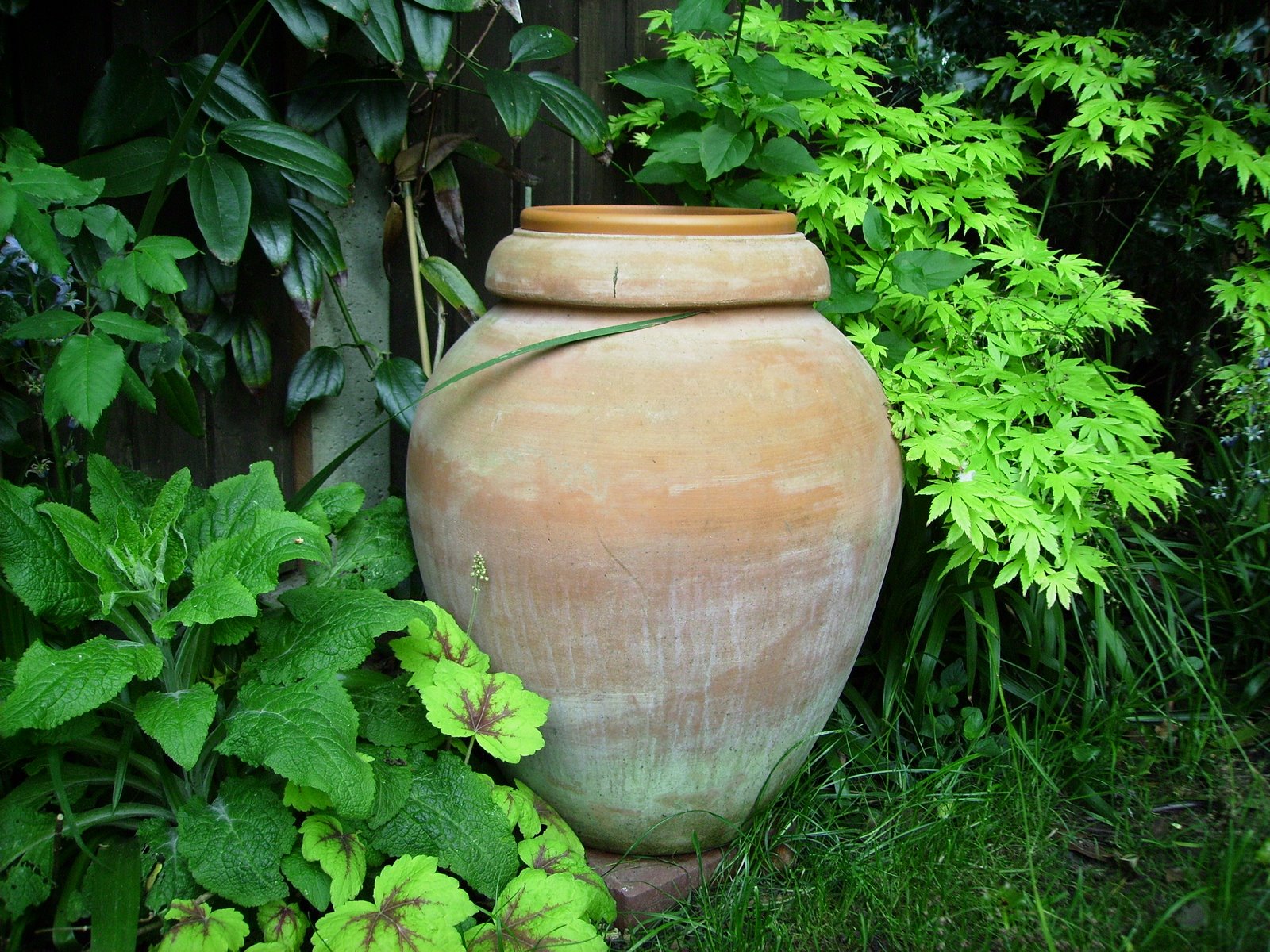
Last time I posted about the garden, I mentioned that I was rejigging this particular bit, and maybe putting in a terracotta pot as a focal point. Well, the pot's there, but I haven't done much else.
Life being what it is, I went down with a cold in the middle of last week, so two glorious days of sunshine this weekend - a golden opportunity to get on with some gardening - has been somewhat disrupted by endless sniffling and coughing.
I've managed to get quite a lot done, but Nature has managed even more - everything seems to be racing ahead. These hostas were scarcely showing their noses above the soil a couple of weeks ago - now they're burgeoning fast.


It feels more like June than April, so it is a bit disconcerting to look around the garden and find that there are no bananas, or cannas, or eucomis in place yet. They're still sitting in the garage, or in the glasshouse at the nursery.
The great thing about blogging is that you have a good excuse to straighten your aching back and head inside to get the camera. The bad thing about blogging is that you then go round the garden with the camera and notice all the untidy bits. So you put down the camera and start deadheading or whatever.
I had this stupid fantasy that I might get a minute to sit in the sun and read a gardening magazine.

Instead, I put up these wall units which you can just see at the back of the picture. They're from Ikea. Well, at least it was furniture-related, even if I didn't get to sit down.

Thursday, April 7, 2011

A post about Pushkin


Some of you already know that my cat, Pushkin, has been through a bit of a bad time recently. He has injured his back, and this has been a huge worry. At one point, we thought we might have to have him put down, but I'm hoping that won't prove to be the case. Apart from his fracture, he's a very healthy cat and the children and I find the thought of life without him very sad indeed.
Apparently, he has a couple of fused vertebrae in his back. Beneath this area is a bony deposit, and it is this deposit that has fractured. This in itself wouldn't be a problem, but a bit of the bone has broken off and is causing him discomfort.
Pushkin has been to see a specialist orthopaedic vet who says that this bone may be pressing on nerves and affecting his back legs. We're currently waiting to take him for an MRI scan which will show what impact this is having on the spinal column. It could be just a case of simply removing the bit of bone in an operation, but we don't know until he has the scan.
I thought I'd write about this because at various points, we almost gave up on Pushkin - but thanks to the internet, we didn't. If anyone else is unlucky enough to go through this sort of distressing experience, I hope this will be of help.
When Pushkin first injured himself, he went missing and we eventually found him cowering in the garden. He flinched away from us when we tried to pick him up and wouldn't even miaow. He then went missing again, which meant a delay of a few days before we could get him to the vet. During this time, we were convinced we would never see him again.
However, I remembered that Yolanda at Bliss had blogged about losing her cat Vita. I read her account of how they hunted for Vita for weeks and it gave me hope that I might find Pushkin.
I also found a blog called
Pet Detective which doesn't seem to be active any more, but which has some invaluable advice for cat owners.
First, when your cat is ill or injured, he doesn't "go off to die" as many people, including me, tend to think. It is his natural instinct to hide, and not to make a sound, so as not to attract the attention of predators when he is not in a fit state to fight them off.
Second, he really will hide - yes, even from you, his loving owner. It's not enough to leaflet neighbours - you have to get down on your hands and knees and crawl around their garden. Even when we got Pushkin safely back in the house, he still managed to tuck himself away in corners and crevices.
On one occasion, I left him shut in the study while I answered the door and when I came back he was gone. I thought I was going mad! In the end, we discovered he'd tucked himself into a cupboard full of DVDs. (And this with a bad back.)
This instinct is called "hiding in silence" and while it might be useful for avoiding predators, it is the worst thing a domestic cat can do. While he's hiding, he's not eating, or drinking, or receiving medical attention, which means that his condition will deteriorate much more quickly.
At the moment, Pushkin is doing quite well. He's eating loads and his back legs seem to be working, after a fashion, though they get a bit tangled up if he tries to turn round too fast. I'm praying that the vet will be able to sort him out. He's far too lovable to lose!

Friday, April 1, 2011

Sssh, I'm re-reading my garden

I was at parents' evening at my daughter's school the other day, and listening to her English teacher talking about re-reading the set text - in this case, Tess of the D'Urbervilles. He was saying that the more one studies a book, the more you find in it the second, third, or twelfth time round.
I am a great re-reader of books. I have what I call "flu books" - novels that I re-read when I'm feeling a bit under the weather. These include all of Jane Austen, Elizabeth Arnim's The Enchanted April, E F Benson's Mapp and Lucia series and Stella Gibbons' Nightingale Wood.
This last was recently republished in paperback, I'm delighted to say, and more will be available in August. I'm a huge fan of Stella Gibbons, who wrote dozens of novels, hardly any of which have been in print for years.
As well as falling with delight upon favourite phrases, it's amazing how often you notice something new, even in a book that is dog-eared with years of use. As one's experience of life increases, so does one's insight and perspective, I suppose.
The same goes for gardening books. The more years I spend gardening, the more I find that I see certain chapters in a new light. Something I may have flicked over four or five years ago now holds my attention. It's like learning a language: suddenly, all those unfamiliar phrases make sense.
This also helps me re-read my garden. I think we all have a corner, a bed or a problem patch that somehow, whatever we do, just refuses to come right. I've got a bit on the right-hand side of my garden that I've never really got to work. I've looked at it, and looked at it, and never until now had the courage to rip it apart and start again.
One day a couple of weeks ago, I was flipping through some books on Oriental and exotic garden design and wishing I had a rare Chinese ceramic shrine like the one in the picture. Then it struck me (the realisation, not the ceramic shrine) - I like the look of something that's motionless and monolithic amongst the movement and jumble of leaves and flowers and bees and whatever else is rustling in the undergrowth. That's what drew me to the picture.
Perhaps this explains why there are so many empty pots (focal points, as I like to think of them) in my garden. Perhaps what I needed was one more, in the middle of this particular bed...
I'll let you know if it works or not.

The bit of border in question, in high summer last year.